

The United States has launched a new strategic framework aimed at reshaping global supply chains critical to artificial intelligence, semiconductors and advanced manufacturing, reflecting a growing consensus that economic security and national security are now deeply intertwined. Known as Pax Silica, the initiative seeks to coordinate investment, production capacity and policy alignment across trusted partner nations that play central roles in the global AI ecosystem.
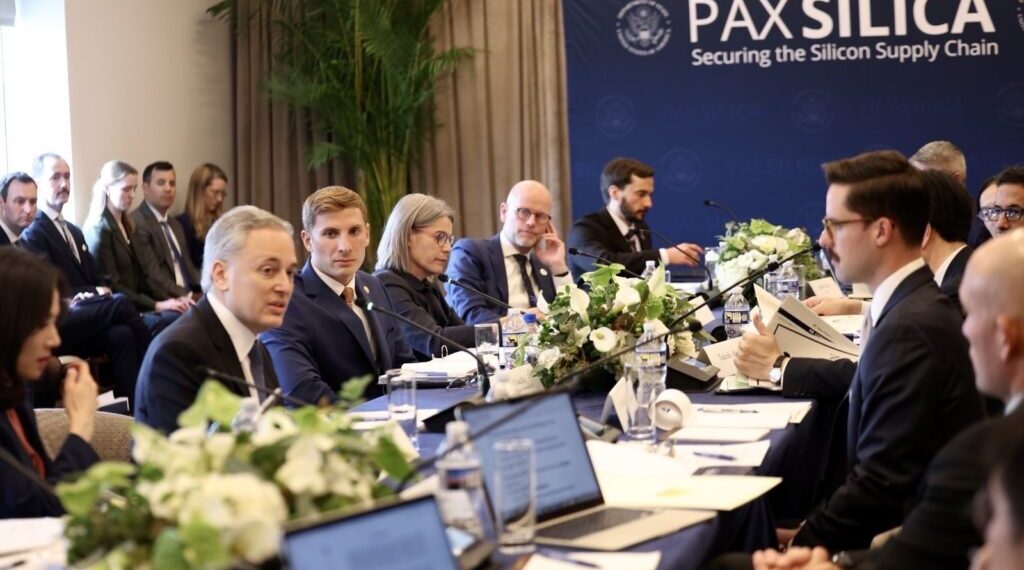
The framework was introduced on December 12 at the inaugural Pax Silica Summit, convened by Jacob Helberg, Under Secretary of State for Economic Affairs, and brought together senior officials and industry stakeholders from Japan, the Republic of Korea, Singapore, the Netherlands, Israel, the United Arab Emirates, the United Kingdom and Australia. Representatives from Taiwan, the European Union, Canada and the Organisation for Economic Co-operation and Development (OECD) also contributed to the discussions.
Together, these economies host many of the world’s most influential technology firms and investors across the AI supply chain, spanning semiconductor design and manufacturing, chipmaking equipment, advanced materials, energy, cloud infrastructure and logistics. Companies based in participating countries include Samsung, SK Hynix, ASML, Sony, Hitachi, Fujitsu, Rio Tinto, Temasek, DeepMind and MGX.
U.S. officials described Pax Silica as a coordination platform rather than a formal alliance, designed to strengthen cooperation among countries seeking to build resilient, innovation-driven technology ecosystems. The initiative emphasizes collaboration with partners that share commitments to market-based principles, technology security and long-term industrial competitiveness, while avoiding a framework framed explicitly around exclusion or decoupling.
The launch reflects a broader reassessment underway among advanced economies following years of supply chain disruption, geopolitical tension and rapid acceleration in AI-driven demand. Semiconductors, advanced computing systems and the energy required to power them have increasingly been recognized as strategic assets, underpinning not only commercial competitiveness but also defense capabilities and critical infrastructure.
Artificial intelligence has intensified these dynamics. As AI models grow more complex and compute-intensive, demand for advanced chips, data centers, high-speed connectivity and reliable power has surged. At the same time, policymakers have become more focused on the risks associated with supply concentration, single points of failure and non-market practices that could undermine access to critical technologies.
Against this backdrop, Pax Silica aims to coordinate efforts across the full AI and semiconductor value chain—from critical minerals and energy inputs to chip fabrication, advanced packaging, manufacturing equipment, data infrastructure and global logistics. Participants discussed how joint planning and investment could help expand productive capacity, support long-term offtake arrangements and reduce vulnerabilities linked to coercive dependencies.
Summit discussions also addressed the need for policy alignment on issues such as overcapacity, dumping and technology protection, as well as mechanisms to safeguard sensitive infrastructure from undue foreign influence. While officials avoided naming specific countries, the focus on trusted ecosystems reflects a broader trend toward selective globalization in high-technology sectors.
The name Pax Silica draws on historical concepts of stability and prosperity associated with economic order, combined with a reference to silicon, the elemental foundation of modern computing. U.S. officials said the concept reflects an ambition to establish a durable framework capable of supporting sustained growth and innovation in an AI-driven global economy.
Participants emphasized that the initiative is intended to be positive-sum, focusing on coordination rather than isolation. Rather than restricting access to markets or technologies, Pax Silica seeks to align countries that host complementary strengths across the technology stack, enabling them to scale innovation together while maintaining secure and trusted supply chains.
A recurring theme at the summit was the recognition that no single country dominates all critical components of the AI supply chain. Leadership instead depends on effective collaboration across borders, combining expertise in areas such as advanced chipmaking equipment, memory manufacturing, materials processing, energy production and AI software development.
Beyond industrial capacity, workforce development also featured prominently in discussions. Participants highlighted the need to expand the pool of skilled engineers, technicians and AI specialists required to support large-scale deployment of advanced manufacturing and digital infrastructure. Coordinated training initiatives and knowledge-sharing mechanisms were identified as potential areas for collaboration.
As an initial step toward implementation, Under Secretary Helberg directed U.S. diplomats in Washington and overseas to begin operationalizing the summit’s outcomes. This includes identifying priority infrastructure projects, facilitating cross-border investment and integrating economic security considerations into ongoing diplomatic and commercial engagement with partner countries.
Guidance related to Pax Silica has been circulated across the U.S. State Department and overseas missions, signaling that the framework is intended to influence practical policy coordination rather than remain a symbolic initiative. Officials indicated that follow-on meetings and working groups are expected as participating countries move toward concrete projects.
While Pax Silica remains in its early stages, analysts say it reflects a broader shift in how governments approach the governance of advanced technologies.