

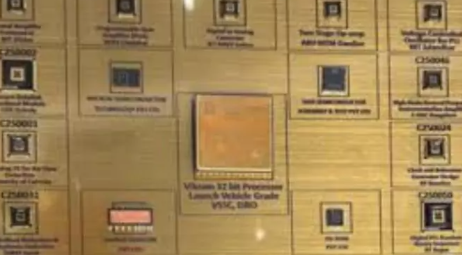
India officially joined the elite group of nations capable of designing and manufacturing advanced microprocessors with the unveiling of Vikram-32, the country’s first fully indigenous 32-bit microprocessor. Developed by the Indian Space Research Organisation (ISRO) through its Semiconductor Laboratory (SCL) in Chandigarh, the chip was presented to Prime Minister Narendra Modi by Union Minister for Electronics and Information Technology, Ashwini Vaishnaw, at the Semicon India 2025 conference in New Delhi. This landmark event marked a defining moment in India’s journey toward technological self-reliance and semiconductor sovereignty.
Historical Context: From VIKRAM1601 to Vikram-32
India’s journey in semiconductor design has been gradual but determined. In 2009, ISRO developed the VIKRAM1601, a 16-bit microprocessor that powered launch vehicles and embedded systems, marking the nation’s first step into space-grade chip design. Over the next decade, the SCL team steadily expanded its capabilities in custom ISA development, radiation-hardened design, and robust fabrication techniques.
The Vikram-32 is the culmination of years of research, representing a leap from 16-bit to 32-bit architecture with enhanced computational ability and resilience. Globally, space-grade processors such as NASA’s RAD750 (USA) and ESA’s LEON3 (Europe) have long set benchmarks for radiation-hardened, reliable chips. While RAD750 operates at 200 MHz with high power consumption and LEON3 focuses on ESA spacecraft, Vikram-32 matches global space-grade standards in reliability while being fully designed and manufactured in India, signaling a sovereign alternative to dependence on foreign IP and technology.
Technical Specifications and Design Depth
Vikram-32 is a 32-bit microprocessor with a custom Instruction Set Architecture (ISA), designed for mission-critical applications. Its key technical features include:
- Clock Speed & Power: 100 MHz with power consumption under 500 mW and quiescent current below 10 mA.
- Durability: Designed to operate in extreme conditions, from -55°C to 125°C, ensuring reliability in launch vehicles and satellites.
- Radiation Hardening: Engineered to resist high-energy cosmic radiation, critical for space missions.
- Packaging: 181-pin Ceramic Pin Grid Array (CPGA) for ruggedized deployment.
- Software Ecosystem: Full support for the Ada programming language, known for safety-critical aerospace systems. ISRO also developed the entire toolchain in-house — including compilers, linkers, simulators, and IDEs.
The custom ISA is one of Vikram-32’s defining features. It supports 152 instructions, including arithmetic, logic, memory access, and control flow operations. It has 256 software interrupts, four 32-bit timers, and dual 1553B bus interfaces, enabling precise, real-time operations for space missions. The ISA’s tailored design ensures deterministic behavior, a critical requirement for mission-critical calculations, navigation, and telemetry.
Applications in Space Missions
The Vikram-32 chip has already been validated in orbit aboard the PSLV-C60 mission, embedded in the Mission Management Computer of the POEM-4 module. Its role spans navigation, guidance, telemetry, and mission-critical computations — ensuring that satellites and launch vehicles maintain precise control under extreme conditions.
Looking forward, Vikram-32 is expected to power future ISRO missions, including deep-space probes, satellite constellations, and autonomous modules in lunar or interplanetary missions. Its radiation-hardened design makes it suitable for long-duration orbital operations, marking a critical step toward fully indigenous spacecraft electronics.
Civilian and Commercial Applications
While Vikram-32 is designed for space, its versatility opens avenues in civilian sectors:
- Automotive Electronics: Electric vehicle control units and autonomous driving systems.
- Industrial Automation & IoT: Sensors, controllers, and smart grid modules.
- Consumer Electronics: Ruggedized devices and local smart electronics.
- Startups & Innovation: Potential collaborations with Indian startups to prototype chips for commercial devices, reducing reliance on imported processors.
By bridging space-grade reliability with civilian adaptability, Vikram-32 strengthens India’s domestic manufacturing ecosystem while lowering costs and fostering innovation.
Strategic and Geopolitical Significance
Vikram-32 embodies India’s Aatmanirbhar Bharat vision, aiming to reduce dependence on foreign semiconductor supply chains dominated by Taiwan, South Korea, the US, and China. The chip’s success is a strategic asset for:
- Defense & National Security: Sovereign technology ensures critical defense and infrastructure systems operate independently.
- AI & IoT Ecosystem: Enables domestic innovation in emerging technologies while safeguarding sensitive data.
- Geopolitical Leverage: Positions India as a trusted global partner for semiconductor supply, amid global supply chain uncertainties.
Prime Minister Modi called semiconductor chips “digital diamonds,” emphasizing their centrality in economic security, defense, and technological leadership.
Challenges in Production
The development of Vikram-32 was fraught with technical and logistical challenges:
- Design Complexity: Crafting a custom ISA and ensuring mission-critical reliability.
- Fabrication Challenges: Establishing a 180nm CMOS fabrication facility in Mohali with high yield rates.
- Radiation-Hardening: Ensuring chip stability under cosmic radiation and thermal extremes.
- Supply Chain Constraints: Procuring specialized materials, high-precision equipment, and skilled manpower.
- Tool Development: Creating compilers, IDEs, simulators, and testing platforms entirely in-house.
The successful launch and validation signify India’s growing engineering prowess and resilience in semiconductor development.
India’s Semiconductor Ecosystem
The Vikram-32 milestone reflects the broader India Semiconductor Mission (ISM), launched in 2021 with a ₹76,000 crore investment to build a comprehensive semiconductor ecosystem. Key highlights:
- Manufacturing Infrastructure: Five fabrication units under construction and ten more planned, backed by $18 billion in investment.
- Global Collaborations: R&D centers of Intel, Qualcomm, Nvidia, and MediaTek leverage India’s 20% share of global chip design engineers.
- Talent Development: Chip design courses, research grants, and startup incubation programs strengthen the workforce pipeline.
- Economic Potential: India’s chip market is projected to reach $100–110 billion by 2030, driven by smartphones, EVs, AI, and defense electronics.
Vikram-32 also complements other indigenous efforts like Shakti processors, demonstrating India’s full-stack capabilities — from design to packaging and testing.
Future Roadmap
Vikram-32 is foundational, not an endgame. Future directions include:
- Next-Gen Chips: 64-bit processors for advanced space and AI applications.
- Smaller Nodes: Moving to 28nm, 14nm, or below for higher performance and energy efficiency.
- AI & Specialized Accelerators: Chips tailored for artificial intelligence, edge computing, and industrial automation.
- Public-Private Partnerships: Encouraging collaboration to scale fabrication and design capabilities.
- Global Leadership in Niche Areas: Space-grade, ruggedized, and defense-oriented processors where India can compete internationally.
Expert Perspectives
ISRO engineers highlight Vikram-32 as a testament to Indian ingenuity, noting the collaborative effort, precision engineering, and sustained R&D investment. Semiconductor analysts point out that while Vikram-32 is modest compared to commercial chips like Apple’s M-series or AMD Ryzen, it matches global space-grade processors in reliability and functionality. Economically, Vikram-32 signals a reduction in foreign dependence and a boost to domestic high-tech manufacturing.
Human and National Angle
The Vikram-32 is also a story of human effort, innovation, and national pride. A multi-disciplinary team of engineers, scientists, and support staff at SCL worked over several years to bring the vision to reality. The successful launch inspires young engineers and students, strengthening India’s STEM pipeline and showcasing that high-tech indigenous innovation is possible.
Prime Minister Modi and Union Minister Ashwini Vaishnaw emphasized that the chip reflects India’s resilience, ambition, and vision for a self-reliant technological future.
Comparative Perspective
| Feature | Vikram-32 (India) | RAD750 (USA) | LEON3 (Europe) |
| Bit Architecture | 32-bit | 32-bit | 32-bit |
| Clock Speed | 100 MHz | 200 MHz | 100 MHz |
| Power Consumption | <500 mW | ~10 W | ~1 W |
| Radiation Hardened | Yes | Yes | Yes |
| Programming Language | Ada | C/C++ | C/C++ |
| Use Case | Launch vehicles, satellites | Mars rovers, deep space | ESA spacecraft |
While Vikram-32 is not designed to compete with consumer-grade chips, it holds its own among global space-grade processors and sets the stage for India’s semiconductor autonomy.
The Vikram-32 microprocessor represents far more than a technological achievement; it is a statement of sovereignty, vision, and ambition. It marks India’s emergence as a capable player in space-grade semiconductor design and manufacturing. Beyond space, Vikram-32 has the potential to fuel domestic innovation, empower industries, and reduce global dependency.
With advanced nodes, AI chips, and a thriving semiconductor ecosystem on the horizon, India is not merely participating in the global semiconductor race—it is laying the foundation to lead in specialized, resilient, and sovereign microprocessor technologies.