


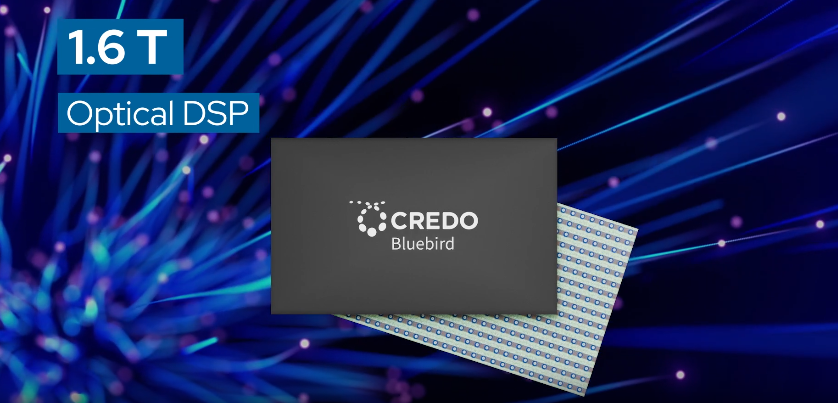
Credo Technology Group Holding Ltd. (NASDAQ: CRDO) has introduced its Bluebird Digital Signal Processor (DSP), a low-power solution for 1.6-terabit optical transceivers designed to meet the rising bandwidth and latency demands of artificial intelligence and cloud computing.
The Bluebird DSP enables 224 gigabits per second per lane PAM4 data transmission, a capability seen as critical to unlocking the performance of advanced GPU-based systems. Many of today’s 1.6T transceivers face deployment constraints due to power dissipation and cooling requirements, limiting broader adoption. Credo says Bluebird, which consumes less than 20 watts, addresses these challenges by combining advanced CMOS process technology with its proprietary design techniques.
“Bluebird is engineered to deliver greater flexibility than existing solutions, enabling broader application support,” said Chris Collins, vice president of optical sales and product marketing at Credo. “This milestone highlights our commitment to innovation in the optical industry — offering unmatched performance and energy efficiency while prioritizing long-term value creation for our partners.”
The system supports both 800-gigabit and 1.6-terabit optical transceivers, with options for four or eight lanes of 224Gbps PAM4. It is available in full DSP and Linear Receive Optics (LRO) variants, giving network operators multiple architecture choices for scale-up and scale-out deployments.
Bluebird has been designed to reduce communication bottlenecks between GPUs, keeping latency below 40 nanoseconds in each direction. This feature is expected to enhance the efficiency of large language model training and inference workloads, which are highly sensitive to communication delays. The DSP also incorporates telemetry functions for link monitoring, diagnostics, and failure isolation, aiming to improve system reliability and reduce downtime.
For integration, Credo has equipped Bluebird with dynamic performance optimization tools that balance energy efficiency and link margin depending on deployment conditions. Optional IEEE-compliant inner and outer forward error correction (FEC) extends fiber reach up to 2 kilometers or more, enabling customers to use a single design across varied applications.
The launch underscores the escalating competition among connectivity providers as hyperscale data centers and AI clusters demand faster, more efficient infrastructure. With Bluebird now commercially available, Credo is positioning itself to capture growth in the optical DSP market, where power efficiency and ultra-low latency are becoming critical differentiators.