


Researchers at the Korea Advanced Institute of Science and Technology (KAIST) have developed an ultra-low power phase change memory (PCM) device designed to advance neuromorphic computing and next-generation artificial intelligence (AI) hardware. The breakthrough offers potential to replace conventional DRAM and NAND flash memory while dramatically reducing processing costs and energy consumption.
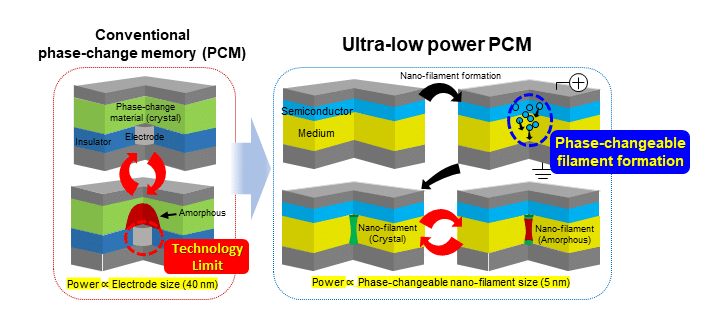
The research, led by Professor Shinhyun Choi from KAIST’s School of Electrical Engineering, was published in the April issue of Nature under the title “Phase-Change Memory via a Phase-Changeable Self-Confined Nano-Filament.” The study highlights a novel approach that allows phase change materials to form extremely small nanometer-scale filaments electrically, eliminating the need for expensive lithography processes while cutting power consumption by a factor of 15 compared with conventional PCM devices.
Phase change memory stores and processes information by switching the crystalline state of a material between amorphous and crystalline, altering its resistance. The technology combines the high-speed performance of DRAM with the non-volatile characteristics of NAND flash memory, offering a versatile memory solution for both storage and computing. This combination positions PCM as a strong candidate for next-generation memory systems and neuromorphic computing platforms, which mimic the human brain’s computational capabilities.
Existing phase change memory technologies, however, have been limited by high power requirements and costly fabrication. Efforts to reduce energy use traditionally focused on shrinking device size through advanced lithography, but these approaches offered limited power savings while increasing complexity and expense.
Professor Choi’s team addressed these challenges by electrically forming phase change materials in a self-confined nanoscale filament. This innovation allows the memory to operate at ultra-low power without the need for intricate fabrication, paving the way for scalable, energy-efficient PCM devices. “The phase change memory device we have developed is significant as it offers a novel approach to solve the lingering problems in producing a memory device at greatly improved manufacturing cost and energy efficiency,” Professor Choi said. “We expect the results of our study to become the foundation of future electronic engineering, enabling applications such as high-density three-dimensional vertical memory and neuromorphic computing systems, while opening possibilities to use a variety of materials.”
The research team includes See-On Park, a student in KAIST’s MS-PhD Integrated Program, and Seokman Hong, a doctoral student in the School of Electrical Engineering, both contributing as first authors. The study was supported by the National Research Foundation of Korea, the National NanoFab Center, and projects including the Next-Generation Intelligent Semiconductor Technology Development Project, the PIM AI Semiconductor Core Technology Development Project, and the Semiconductor Process-based Nanomedical Devices Development Project.
Phase change memory is increasingly viewed as a critical technology for AI and high-performance computing due to its ability to bridge the gap between volatile and non-volatile storage. By combining speed, reliability, and reduced energy consumption, PCM devices could enable neuromorphic computing systems capable of performing complex calculations with efficiencies comparable to biological neural networks. KAIST’s breakthrough could thus accelerate the development of AI hardware that is both high-performing and energy-conscious, addressing one of the key bottlenecks in the field.
Professor Choi acknowledged the broader implications of the research for the semiconductor industry and AI ecosystem. “This development opens the door to practical implementation of neuromorphic systems and high-density memory architectures at a fraction of the energy cost previously required,” he said. “We would like to thank the National Research Foundation of Korea and the National NanoFab Center for supporting this research.”