

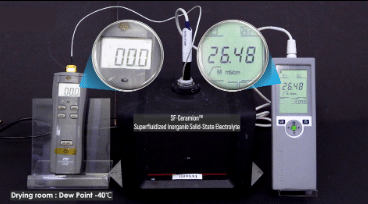
ProLogium Technology, a Taiwan-based battery maker, has introduced a new solid-state electrolyte material called SF-Ceramion. The company claims it offers high conductivity like liquid electrolytes but with the safety and strength of solid materials.
SF-Ceramion is designed to meet the growing need for better electric vehicle (EV) batteries. It is said to combine fluid-like ion movement with thermal and mechanical stability. According to ProLogium, the new material achieves an ionic conductivity of 11 mS/cm at room temperature. This is on par with some liquid electrolytes used in current lithium-ion batteries.
The company also says the material remains stable at temperatures up to 160°C. It reportedly has high resistance to lithium dendrites, which are tiny metal structures that can cause battery short circuits. This makes SF-Ceramion a potential enabler for lithium metal anodes, which are known for higher energy density.
ProLogium’s founder and CEO, Vincent Yang, said the new electrolyte could play a key role in improving both safety and performance. He added that the material is easy to process. It does not require high pressure, sintering, or dry-room conditions during production. This could help lower manufacturing costs and speed up industrial use.
The battery industry is racing to develop solid-state batteries. These offer benefits like faster charging, improved safety, and longer lifespan. Many companies—like Toyota, Solid Power, and QuantumScape—are investing heavily in this technology. But solid-state batteries remain difficult and expensive to scale up.
ProLogium believes its new material addresses some of these challenges. The SF-Ceramion combines high performance with practical production. Its structure reportedly allows for roll-to-roll processing, a standard method used in battery manufacturing. This may make large-scale production easier and cheaper.
The material is currently being validated. ProLogium is testing it internally and with external partners. The company has not shared a specific timeline for commercial rollout. However, it confirmed plans to integrate SF-Ceramion into its future battery products.
Founded in 2006, ProLogium focuses solely on solid-state battery technologies. Over the years, it has built a strong portfolio of patents and has gained interest from global automakers. In 2023, Mercedes-Benz invested in the company. The carmaker sees ProLogium as a long-term technology partner in the EV space.
The global shift toward clean energy is driving demand for safer and more efficient batteries. Governments are pushing for carbon neutrality. Automakers are responding by speeding up EV plans. As battery safety, weight, and charge time become key factors, solid-state technology is viewed as a solution.
However, most solid-state systems are still in development. Many use brittle ceramics that are hard to manufacture. Others struggle with low conductivity or poor cycle life. A breakthrough in materials could change the game.
ProLogium says SF-Ceramion offers a new way forward. It combines the benefits of solid and liquid systems in one platform. If proven at scale, it could enable safer, lighter, and more powerful batteries. This would help meet the demands of future EVs and energy storage systems.
Industry experts are watching closely. Independent testing and third-party validation will be important. Until then, ProLogium’s claims remain to be fully verified. Still, the company’s track record and partnerships lend weight to its announcement.