


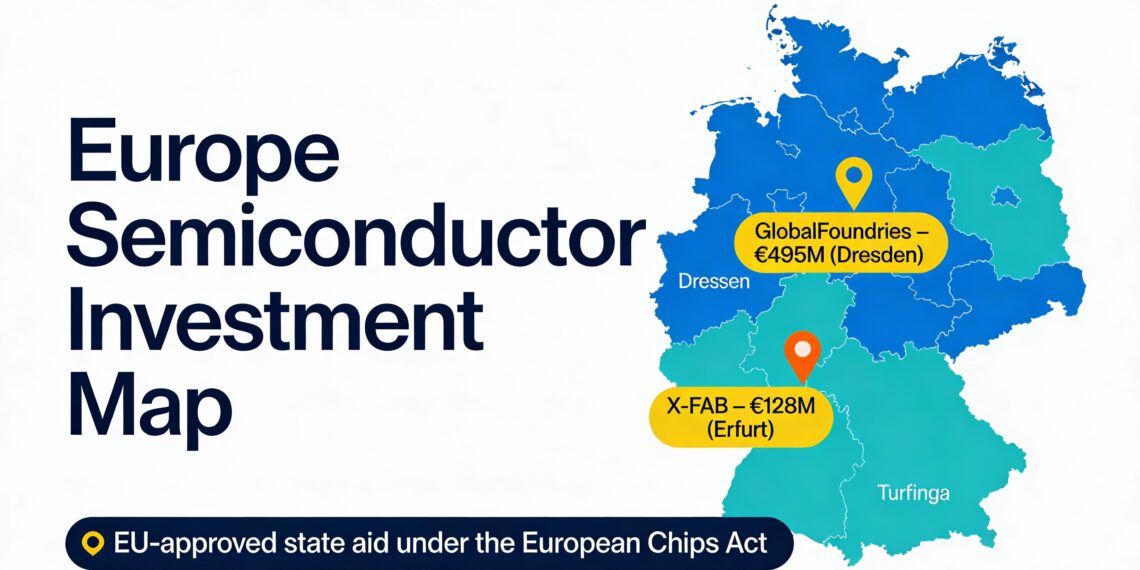
The European Commission has approved €623 million ($670 million) in German state aid to support the construction of two new semiconductor manufacturing facilities, marking another step in the European Union’s push to reduce its dependence on overseas chip supplies and strengthen domestic production capacity.
The funding will back projects led by GlobalFoundries in Dresden and X-FAB in Erfurt, both of which are designed as “first-of-a-kind” facilities under the framework of the European Chips Act. The aid package includes a €495 million direct grant for GlobalFoundries and €128 million for X-FAB, Germany and the Commission said.
The decision aligns with the EU’s broader strategy to increase technological sovereignty in semiconductors, an industry that has become central to economic competitiveness, national security and industrial resilience. Europe currently accounts for less than 10% of global chip manufacturing, with much of the world’s advanced production concentrated in Asia and the United States.
GlobalFoundries’ project, known as SPRINT, will expand and adapt its existing Dresden site to add new 300-millimeter wafer manufacturing capacity. The foundry, which produces chips exclusively for other companies, plans to scale technologies originally developed under the EU’s Important Projects of Common European Interest (IPCEI) for microelectronics. These technologies will be modified for dual-use applications, targeting aerospace, defense and critical infrastructure.
The manufacturing process will take place entirely within Europe and incorporate additional security and reliability features, a requirement for sensitive applications. According to the Commission, this will be the first time such technologies are produced at scale in the EU, making the project a milestone for Europe’s semiconductor ambitions.
X-FAB’s Fab4Micro project will see the construction of a new open foundry facility at its Erfurt site. The factory will combine existing expertise in micro-electromechanical systems, or MEMS, with advanced packaging and integration processes. These chips are increasingly used in automotive systems, artificial intelligence applications and medical devices.
The Erfurt facility is expected to begin commercial operations by 2029 and will offer manufacturing services that are currently unavailable in Europe. It is aimed in particular at fabless chip companies, including startups and small and medium-sized enterprises, many of which currently rely on foundries outside the EU for production.
Both projects are intended to operate as open foundries, providing access to manufacturing capacity for a broad range of customers rather than serving a single company or product line. GlobalFoundries and X-FAB have committed to applying for formal recognition as Open EU Foundries under the European Chips Act, a status that carries obligations related to supply security and crisis response.
As part of the aid conditions, the companies agreed to ensure that the projects deliver wider benefits across the European semiconductor value chain. This includes continued investment in innovation, preparation for next-generation technologies, and the development of education and skills training programs to address labor shortages in the sector.
The firms have also committed to complying with priority-rated orders in the event of a supply shortage, as предусмотрed under the Chips Act, ensuring that European demand can be met during crises. Any project-related profits exceeding current expectations will be shared with Germany, a measure intended to limit market distortions and ensure proportionality of the aid.
In its assessment, the Commission said the measures meet the criteria under Article 107(3)(c) of the EU treaty, which allows state aid to support certain economic activities when it is necessary, appropriate and proportionate. The Commission concluded that the investments would not take place in Europe without public support and that the aid’s impact on competition and trade within the bloc would be limited.
The approvals form part of a wider wave of public investment in Europe’s semiconductor sector. Since the adoption of the European Chips Act framework, the Commission has approved aid measures totaling about €13.2 billion across multiple member states, supporting a range of chip technologies and manufacturing capabilities.
Germany launched a call for proposals in November 2024 for innovative projects across the semiconductor value chain, including manufacturing, advanced packaging, equipment and materials. The GlobalFoundries and X-FAB projects are the first two selected under that program.
The European Chips Act, which entered into force in September 2023, was designed to mobilize more than €43 billion in public and private investment by the end of the decade. While the EU is unlikely to rival Asia’s largest chipmakers in the most advanced nodes, policymakers are betting that targeted investments in specialty, industrial and secure chips can give Europe a stronger and more resilient position in the global semiconductor landscape.