


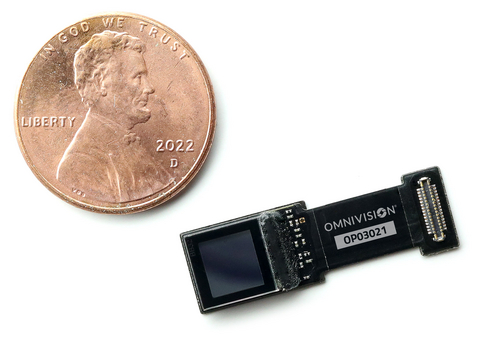
OMNIVISION has announced the launch of what it describes as the industry’s lowest-power single-chip, full-color sequential microdisplay for next-generation smart glasses. The newly introduced OP03021 liquid crystal on silicon (LCOS) panel is designed to meet growing demand for higher resolution, wider field of view, and improved energy efficiency in augmented reality wearables.
The OP03021 LCOS microdisplay delivers a resolution of 1632 × 1536 at a 90 Hz refresh rate in a compact 0.26-inch optical format. According to the company, this combination allows smart glasses designers to achieve sharper visuals while expanding the field of view, both of which are key requirements for delivering more immersive and comfortable augmented reality experiences. As smart glasses move closer to mainstream adoption, factors such as display clarity, form factor, and power consumption are becoming increasingly critical.
OMNIVISION positions the OP03021 as the industry’s only single-chip LCOS panel to offer ultra-low power operation alongside full-color sequential display capability. By consolidating display functions into a single chip, the panel reduces system complexity while enabling lighter and more compact product designs. This approach is intended to support the development of smart glasses that can be worn comfortably for extended periods.
According to Devang Patel, marketing director for the IoT and emerging segment at OMNIVISION, the new LCOS panel addresses both performance and design challenges faced by smart glasses manufacturers. He noted that higher resolution and expanded field of view, combined with low power consumption, help make smart glasses more fashionable and practical for everyday use. Patel also pointed to the rapid growth of smart glasses as a consumer technology category, suggesting their adoption could eventually rival that of smartphones.
Industry analyst Karl Guttag, president of KGOnTech, highlighted the technical integration of the OP03021 LCOS panel. The device incorporates a smaller 3.0-micron pixel along with integrated control circuitry, frame buffer memory, and a MIPI receiver directly on the silicon backplane. This level of integration helps reduce both overall system size and power consumption, two of the most significant constraints in wearable display design.
From a technical standpoint, the OP03021 supports field-sequential color operation at 90 Hz and uses a MIPI C-PHY 1-trio interface for input. The panel is delivered in a compact flexible printed circuit assembly (FPCA) package, further supporting space-constrained designs.
With the launch of the OP03021, OMNIVISION aims to strengthen its position in the emerging smart glasses ecosystem.