

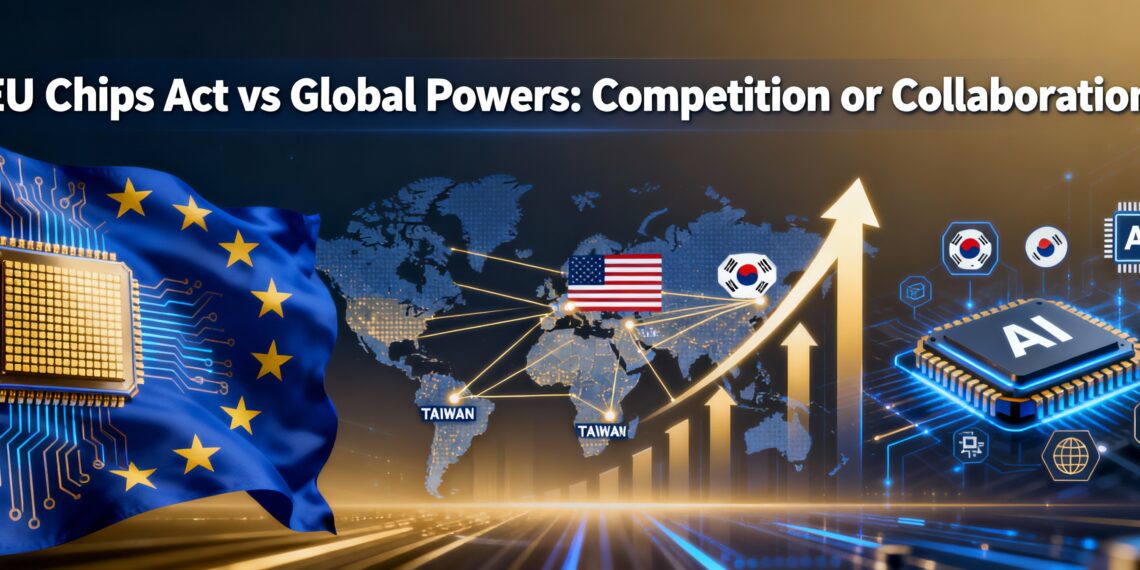
As the world races to control the semiconductor supply chain—the modern backbone of everything from smartphones to electric vehicles—Europe finds itself at a critical crossroads. While Taiwan’s TSMC commands over two-thirds of global chip manufacturing revenue and South Korea’s Samsung remains a dominant force, the European Union is striving to reshape the narrative with its ambitious EU Chips Act. Launched in 2022 with a staggering €43 billion in funding, this initiative aims to double Europe’s chip manufacturing share from 10% to 20% by 2030. But is this bold vision part of a cutthroat global scramble, or a subtle dance of competition blended with collaboration? The answer likely lies in a complex fusion of both.
Europe’s Bold Gamble: More Than Just Dollars
Unlike its US counterpart—the CHIPS Act—which dangles $52 billion primarily through tax credits aimed at building massive chip fabs, Europe’s strategy is multifaceted. The EU Chips Act not only injects over €31.5 billion into state aid but also strategically invests in design ecosystems, pilot production lines, and advanced research centers scattered across member states. Germany alone leads with a commitment exceeding €48 billion featuring projects by Intel, Infineon, and Wolfspeed. These numbers, however colossal, convey something deeper: Europe is betting on sustainable semiconductor sovereignty by developing a comprehensive innovation ecosystem rather than just chasing the fastest nodes or largest fabs.
Parallel Paths, Diverging Approaches
The US approach prioritizes scale and control—building fabs from the ground up, expanding capacity to loosen dependence on Asia, and aggressively curtailing China’s semiconductor ambitions through export controls. Europe’s method embraces collaboration, opening doors for startups and intellectual property sharing, while actively encouraging alliances with trusted “like-minded” partners such as Taiwan and Japan. Where the US erects barriers, the EU seeks bridges, positioning itself as a diplomatic and industrial broker in a fractured global landscape.
This distinction is critical. Taiwan’s TSMC, while holding a near-monopoly on the most advanced chips (below 5nm), remains cautious about large-scale expansion in Europe, citing costs and labor constraints. Meanwhile, Japan and South Korea move forward with carefully calibrated investments backed by their own geopolitical priorities. The semiconductor industry is no longer about isolated national might but intertwined global dependencies.
Shared Challenges Forge Unlikely Partnerships
Natural disasters in Taiwan, China’s aggressive legacy chip overproduction, and persistent workforce shortages are existential threats to global tech supply chains. Europe’s Semiconductor Supply Chains Act responds by safeguarding mature nodes vital to automotive and industrial sectors, while its talent gap looms large—with estimates forecasting a shortfall of over 270,000 qualified workers by 2030.
It’s against this backdrop of vulnerability that collaboration emerges as a necessity rather than choice. EU-Taiwan joint research agreements and integrated US-EU funding mechanisms are practical manifestations of this reality—Chinese chips may be sidelined, but mutual reliance among democratic nations is intensifying. Draft proposals for a Chips Act 2.0 envision streamlined investment frameworks spanning continents, underscoring that semiconductor security hinges on collective strength.
Real-World Wins Illuminate the Path
Mixed competition and cooperation yield concrete results. Intel’s $33 billion Magdeburg fab melds US capital with German subsidies to create thousands of jobs. GlobalFoundries expands across Europe on dual incentives, joining STMicroelectronics in a growing constellation of supported fabs. ASML’s collaboration with TSMC pushes lithography technology forward, while Samsung’s $5.7 billion Texas fab binds Asian expertise to North American production. Europe’s 12 mega-project approvals in 2025 signal momentum but also underline the tension: top-tier node production remains a future goal.
The Future Lies in Balance
The semiconductor story today is not one of pure rivalry nor of handholding détente. It is a delicate balancing act where the US flexes raw industrial power, Europe curates innovation ecosystems, and Asia supplies unparalleled volume and technical prowess. President Trump’s “America First” rhetoric and China’s robust push for self-reliance complicate matters, yet the EU’s nuanced role as a connector and investor may prove decisive.
Success depends on execution—speeding permits, educating and retaining talent, and harmonizing regulatory frameworks. If the various Chips Acts can evolve into a cohesive “global semiconductor resilience network,” they will transform chips from geopolitical tinderboxes into infrastructure that powers sustainable innovation worldwide.