


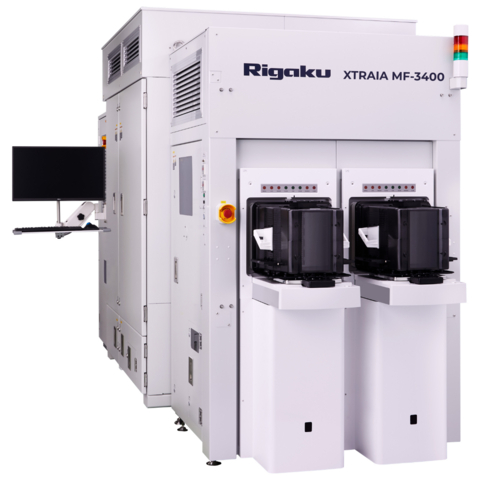
Rigaku Corp. has introduced a new semiconductor measurement system aimed at supporting the next wave of advanced chip manufacturing, as demand accelerates for high-performance components used in artificial intelligence and data-center infrastructure.
The XTRAIA MF-3400, unveiled by the Tokyo-based X-ray analytics specialist, is designed to measure wafer thickness and material composition with nanoscale precision — capabilities that are increasingly critical as chipmakers push toward denser, more complex semiconductor structures. The launch comes amid intensifying competition among equipment suppliers to meet the needs of manufacturers developing next-generation memory and high-speed AI processors.
Global demand for semiconductors capable of handling massive datasets continues to surge as generative AI technologies proliferate. That trend is reshaping chip architectures: billions of microscopic electronic components are now stacked in intricate, three-dimensional layouts that require nondestructive inspection techniques to maintain yield and production stability. Rigaku said the MF-3400 advances the company’s decades of X-ray engineering to deliver faster, finer measurements at a scale suited for mass production.
One key addition is support for molybdenum analysis, a material gaining traction in semiconductor development for its conductivity and stability at microscopic dimensions. The instrument also doubles the X-ray dose compared with earlier models and integrates a redesigned transport system, enabling significantly more wafer measurements per hour. On measurement fields narrower than a human hair, the MF-3400 can determine film thickness with sub-nanometer accuracy — finer than the width of a single atom.
The platform consolidates three X-ray analytical techniques — fluorescence, reflectance and diffraction — into a single system. Automated recipes allow chipmakers to run multiple types of structural, thickness or crystallinity analyses without halting production lines, a feature Rigaku says aligns with factories’ push for higher throughput and lower defect rates.
Kioxia Corp. and its manufacturing arm in Iwate Prefecture will deploy the MF-3400 across mass-production lines for 3D NAND flash memory, a core storage component used in data-center and AI hardware. Rigaku expects the tool will also be adopted for next-generation memory formats requiring higher capacity and faster data transfer speeds, with DRAM and logic manufacturers projected to follow.
Rigaku forecasts that, combining sales of the MF-3400 and its predecessor, revenue will exceed ¥6 billion in fiscal 2026. The system’s modular design allows chipmakers to tailor configurations to specific process requirements, a flexibility the company believes will support wider adoption across emerging semiconductor materials and architectures. Rigaku aims to grow annual revenue for the XTRAIA series by 20% from fiscal 2027 onward as it expands into new process segments.