

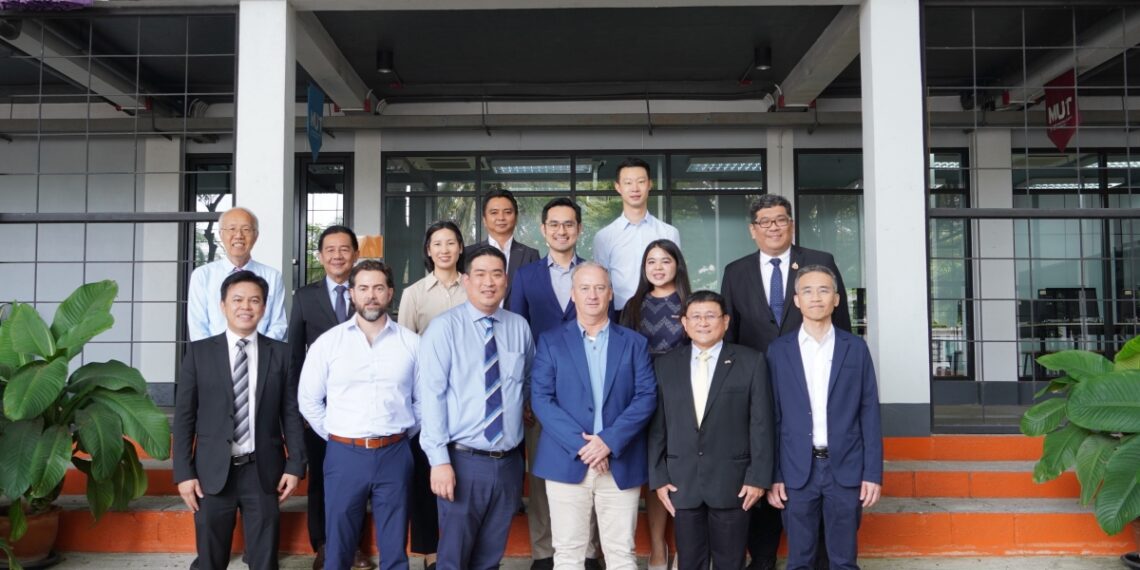
Thailand is strengthening its semiconductor ecosystem through an expanded partnership with Arizona State University (ASU), focusing on workforce development, research, and education in microelectronics. The collaboration, led by Thailand’s Ministry of Higher Education, Science, Research and Innovation (MHESI) and Mahanakorn University of Technology (MUT), builds on a memorandum of understanding signed in September to advance education and research in semiconductor technologies.
“This partnership represents a shared effort to build the talent and innovation that will drive Thailand’s semiconductor future,” said Professor Supachai Pathumnakul, permanent secretary at MHESI. “Combining Thailand’s national vision with ASU’s expertise creates an ecosystem where education, research, and industry advance together.”
The first initiative under this collaboration involves 21 Thai faculty and professionals participating in ASU’s Semiconductor Ecosystem Master Class, a six-week executive program delivered by the Ira A. Fulton Schools of Engineering. The program, which began on October 20, provides an overview of the semiconductor industry, covering design, fabrication, packaging, testing, and supply chain strategies while emphasizing collaboration between academia, government, and industry.
“The master class offered a comprehensive overview of the semiconductor value chain and demonstrated how academia and industry can collaborate to advance Thailand’s semiconductor development,” said Associate Professor Chiranut Sa-Ngiamsak of Khon Kaen University.
MUT President Associate Professor Panavy Pookaiyaudom added that the program reinforces Thailand’s potential to develop its semiconductor education, research, and industrial capabilities. “With strong leadership from MHESI, Thailand is well-positioned to become a key contributor to Southeast Asia’s semiconductor ecosystem.”
The master class is part of four flagship programs planned for the 2025–2026 academic year, including a government and industry workshop, in-country semiconductor microcredentials for engineers and technicians, and a Semiconductor Curriculum Accelerator to support faculty in developing semiconductor-aligned courses.
“These pilot programs engage more than 200 participants in the first six months and lay the groundwork for a broader multi-year strategy,” said ASU Associate Vice Provost Jeff Goss. “They support Thailand’s efforts to establish itself as a regional hub for semiconductor manufacturing, packaging, and advanced technologies.”
The broader initiative, the Thai-U.S. Alliance for Semiconductor Excellence, involves ASU, MHESI, MUT, the Thailand Board of Investment, and the Thailand Microelectronics Center (TMEC). It aims to establish centers of excellence in semiconductors, advanced packaging, microelectronics, embedded systems, and AI-integrated smart manufacturing. TMEC will serve as a regional training and innovation hub to support industry growth across Southeast Asia.
“This collaboration is a critical step to expand Thailand’s capabilities in higher-value segments of the semiconductor supply chain, including wafer fabrication,” said Adisorn Tuantranont, director of TMEC.
The partnership aligns with Thailand’s national roadmap for semiconductors, focusing on workforce development and attracting high-value investments to advance the country’s semiconductor industry.