


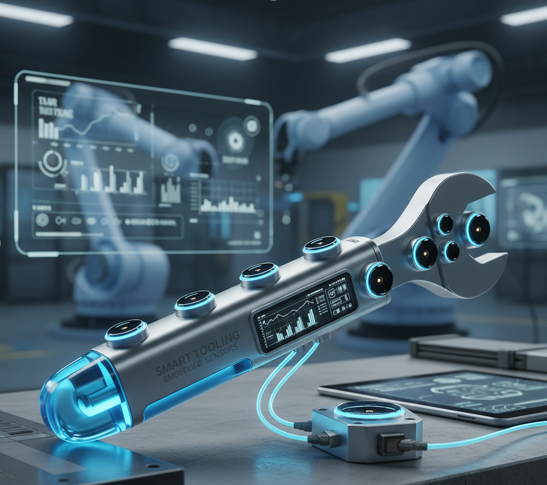
The global market for smart tooling with embedded sensors is poised for significant growth, with its value projected to rise from $2.1 billion in 2024 to $8.7 billion by 2033, according to a report by Research Intelo. The market is expected to expand at a robust CAGR of 17.2% during the 2025–2033 forecast period, driven primarily by increasing demand for real-time data analytics and predictive maintenance across industrial sectors. Manufacturers and service providers are seeking solutions that optimize operational efficiency, reduce downtime, and extend the lifespan of critical tooling assets. Advanced sensor integration within tooling systems is revolutionizing manufacturing, assembly, and maintenance processes, enabling industries to embrace digital transformation and Industry 4.0 initiatives.
Smart tooling with embedded sensors is at the forefront of this transformation, enhancing precision, efficiency, and real-time control in production environments. These intelligent tools are equipped with sensors that monitor parameters such as pressure, temperature, vibration, and tool wear, allowing dynamic adjustments during machining or assembly operations. The technology is gaining traction across aerospace, automotive, energy, electronics, and heavy machinery sectors, where higher productivity and quality assurance are increasingly critical.
The demand for precision and quality is a key driver of market growth. In sectors such as aerospace and medical devices, manufacturing tolerances are tightening, necessitating reliable tooling solutions. Embedded sensors allow immediate detection of anomalies such as tool deflection or temperature spikes, ensuring consistent part quality and minimizing rework costs. Predictive maintenance is another important factor, as traditional maintenance methods often result in unexpected tool failures and costly downtime. Smart tooling systems monitor wear in real time and alert operators before critical failures occur, helping extend equipment lifespan and streamline production schedules.
The technology aligns seamlessly with Industry 4.0 and the Industrial Internet of Things, feeding sensor data into AI-powered platforms for advanced analytics. This enables closed-loop manufacturing where machines automatically adjust to maintain optimal performance. The integration of smart tools into digital twins further enhances process simulation and operational optimization. Recent advances in MEMS sensors and miniaturized electronics allow sensors to be embedded without compromising mechanical integrity, while heat-resistant materials ensure accurate performance in extreme machining environments.
Applications of smart tooling with embedded sensors span multiple industries. In aerospace, real-time monitoring of cutting forces, vibrations, and temperatures helps maintain surface integrity and component accuracy, particularly when working with titanium and composite materials. Automotive manufacturers use these tools to improve process control and automation in engine block machining, body panel stamping, and battery assembly for electric vehicles, while supporting lightweighting initiatives in aluminum and composite parts. In energy and power generation, smart tooling ensures the production of turbines, pipelines, and high-pressure components remains reliable by monitoring stress and temperature to prevent microcracks. In electronics and semiconductor manufacturing, even slight deviations can cause product failure, and sensor-enabled tools provide micron-level control for processes such as PCB drilling, chip packaging, and microfabrication.
Despite strong growth prospects, challenges remain for market adoption. High initial investment costs, particularly for small and medium-sized manufacturers, and the need for specialized expertise in electronics, data analysis, and machine learning can limit uptake. Data interoperability across multiple machine tool vendors and sensor platforms remains complex, and sensor durability in high-vibration, high-temperature environments continues to be a technical hurdle.
Looking ahead, the market is expected to evolve toward autonomous, self-optimizing manufacturing ecosystems. Real-time sensor feedback will integrate with AI-driven process control systems, enabling automatic parameter adjustments. Developments in wireless data transmission, edge computing, and 5G connectivity are expected to support faster and more reliable communication between tools and control systems. Sustainability will also play a growing role, as sensor-based tooling helps reduce material waste and energy consumption, supporting eco-efficient manufacturing goals. Prominent companies operating in the market include Sandvik AB, Schunk GmbH & Co. KG, Kennametal Inc., BIG KAISER Precision Tooling Ltd., MAPAL Dr. Kress KG, Guhring KG, Haimer GmbH, Hexagon AB, Seco Tools AB, Dormer Pramet, OSG Corporation, Walter AG, and ISCAR Ltd.