


Microchip Technology (Nasdaq: MCHP) and AVIVA Links have achieved a key interoperability milestone under the Automotive SerDes Alliance Motion Link (ASA-ML) open standard, advancing the industry’s shift from proprietary automotive connectivity solutions to open, multi-vendor platforms.
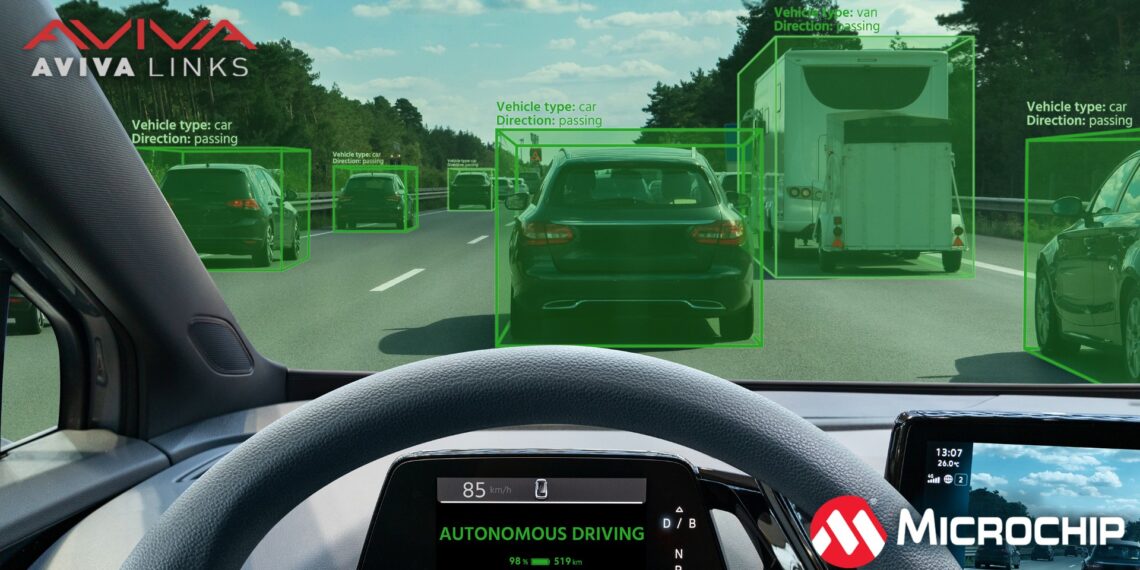
The demonstration showed that ASA-ML chipsets from multiple vendors can operate seamlessly together, providing scalable high-speed connectivity for cameras, sensors, and displays used in Advanced Driver Assistance Systems (ADAS) and In-Vehicle Infotainment (IVI). The milestone underscores the viability of ASA-ML as a standard for next-generation automotive networks.
AVIVA Links, which recently announced a definitive agreement to be acquired by NXP Semiconductors, participated in the interoperability tests with Microchip, signaling industry support for open-standard solutions.
“Achieving robust ASA-ML interoperability with AVIVA Links is a pivotal moment for the Automotive SerDes Alliance,” said Kevin So, vice president of Microchip’s communications business unit. “It gives OEMs and Tier 1 suppliers the confidence to design next-generation ADAS architectures around ASA-ML, backed by leading semiconductor suppliers.”
The Automotive SerDes Alliance, which includes more than 175 members such as BMW, Ford, GM, Hyundai Kia, Nio, Renault/Ampere, Stellantis, Volvo, and Xiaopeng Motors, aims to accelerate adoption of interoperable, standards-based connectivity for vehicles. ASA-ML supports asymmetric high-speed video, control, and data transmission up to 16 gigabits per second, enabling the addition of more cameras and sensors to support L2 and L2+ autonomous driving features.
“Proving interoperability with Microchip’s ASA-ML SerDes chipset is an important milestone for the automotive industry,” said Kamal Dalmia, CEO of AVIVA Links. “Together with our pending acquisition by NXP, it will further drive confidence in ASA-ML adoption at OEMs and Tier 1 suppliers.”
Microchip, which introduced its ASA-ML chipset through the acquisition of VSI Ltd., has previously launched the first ASA-ML camera development platform for the Japanese automotive market. Its VS7000 chipset family is currently available for sampling and can be used in automotive, industrial, medical, and machine vision applications.
The interoperability demonstration addresses industry concerns about vendor lock-in and supply chain risk, while encouraging competition and reducing costs. Analysts expect the proof of multi-vendor ASA-ML capability to accelerate integration into upcoming vehicle platforms for applications including surround view, driver monitoring, and high-resolution displays.