


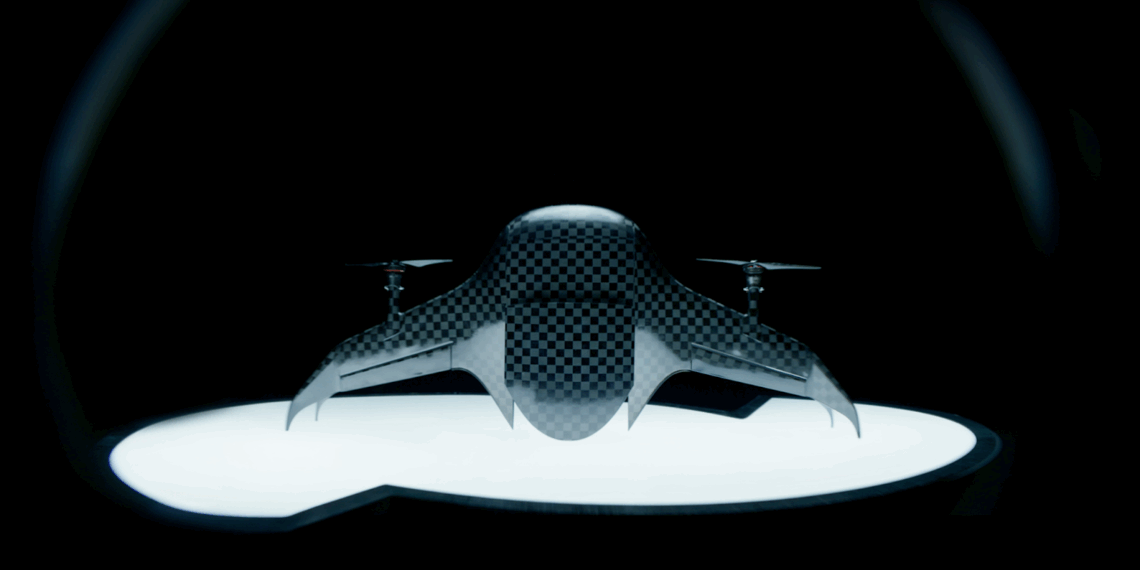
Bengaluru-based autonomous logistics startup Airbound has secured $8.65 million in seed funding and entered into a pilot partnership with Narayana Health to deploy drone-based medical deliveries. The funding round was led by Lachy Groom, co-founder of Physical Intelligence, with participation from Humba Ventures and continued backing from Lightspeed. The round also includes investment from senior leaders at Tesla, Anduril, and Ather Energy, signalling strong conviction from industry veterans experienced in scaling complex hardware and autonomous systems.
Founded in 2023, Airbound is building next-generation blended-wing-body aircraft aimed at transforming logistics by enabling low-cost, reliable, and rapid deliveries across urban, semi-urban, and remote regions. The company’s drones are designed with a proprietary carbon-fibre manufacturing process that allows fast production and high payload efficiency, achieving a payload-to-aircraft mass ratio of 1 kilogram to 1.5 kilograms. Its distinctive tailsitter architecture combines vertical takeoff and landing with the aerodynamic efficiency of fixed-wing flight, a hybrid approach that seeks to overcome the trade-offs faced by conventional tilt-rotor and quadplane designs.
Airbound’s ambition extends beyond simply deploying drones; it aims to build an integrated, borderless logistics network that reduces the cost of delivery to near-zero. The company argues that as traditional supply chains struggle with traffic congestion, limited road access, and high last-mile costs, autonomous aerial logistics can provide a more scalable alternative. “We are grateful to our incoming and current investors for supporting our vision to make the cost of delivery negligible,” said Naman Pushp, Founder and CEO of Airbound. “The healthcare sector represents the perfect testing ground for our technology because it demands both reliability and efficiency. Our partnership with Narayana Health validates that our approach can handle the most critical delivery requirements while demonstrating the cost advantages that will make our service accessible globally.”
The partnership with Narayana Health marks a significant step for Airbound as it pilots real-world applications of its aircraft in one of the most demanding logistics environments. The three-month program aims to complete up to ten medical deliveries per day, transporting blood samples, test kits, and other essential medical supplies between facilities. For Narayana Health, the collaboration represents an exploration into how drone technology can help improve operational efficiency and patient care. “At Narayana Health, we are constantly exploring innovative solutions to enhance patient care and operational efficiency,” said Dr. Devi Shetty, Founder and Chairman of Narayana Health. “Our partnership with Airbound allows us to pilot a promising technology that could significantly improve the speed and reliability of medical deliveries. This initiative reflects our commitment to leveraging technology to better serve patients, particularly in areas where timely access to critical diagnostics and supplies can make a life-saving difference.”
Lachy Groom, who led the funding round, said Airbound’s approach to drone delivery resolves key barriers that have hindered the scalability of earlier solutions. “Airbound’s blended-wing-body design and manufacturing capabilities position them to achieve the cost efficiency needed to make drone delivery truly viable for a wide range of applications,” Groom said.
The seed round brings Airbound’s total funding to more than $10 million. The company plans to use the capital to scale its manufacturing capabilities, expand its operations beyond healthcare logistics, refine its technology stack, and prepare for commercial rollout by 2026. Insights from the Narayana Health pilot are expected to inform Airbound’s broader logistics solutions, helping to optimize delivery economics and accelerate industry adoption.
The Indian logistics sector, long challenged by infrastructure constraints and last-mile inefficiencies, is increasingly turning to automation and aerial systems to improve reach and speed. However, commercial drone delivery remains nascent, hindered by regulatory, cost, and scalability hurdles. Airbound’s technology, if successful in healthcare—a sector that demands both precision and reliability—could provide the proof of concept necessary to expand into mainstream logistics and e-commerce.
For now, Airbound’s progress will be closely watched by investors and policymakers alike as it seeks to demonstrate that drones can move beyond experimentation to become a viable, cost-efficient component of India’s logistics backbone. The success of its pilot with Narayana Health may determine how soon that future takes flight.