




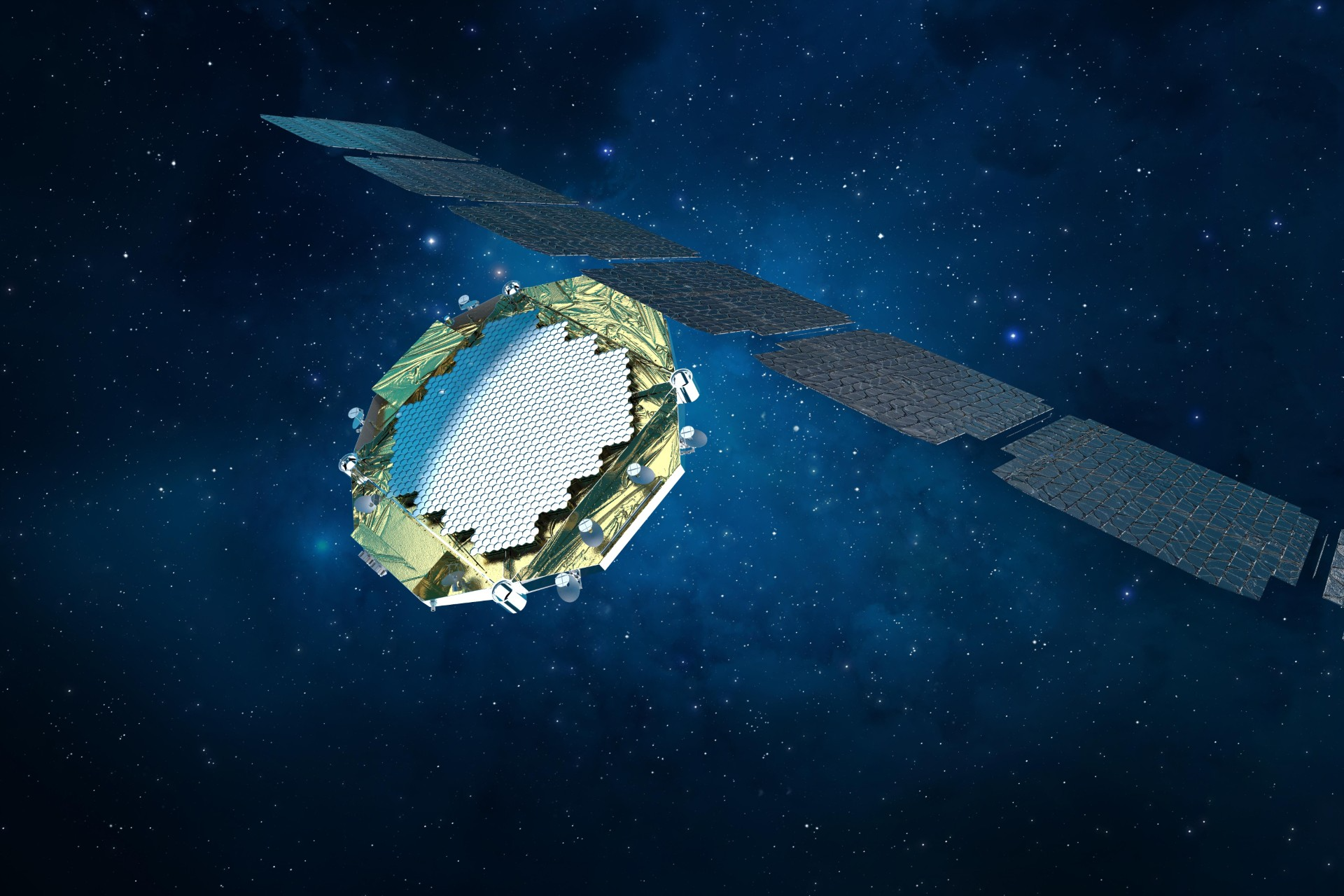
Thales Alenia Space, a joint venture between Thales and Leonardo, will lead a French government-backed project to demonstrate direct 5G connectivity between satellites and mobile devices, in partnership with Capgemini, Thales, and a consortium of technology and telecom firms.
The initiative, called U DESERVE 5G, has been selected by France’s space agency CNES under the France 2030 program. It is designed to test the feasibility of direct-to-device communications via a low-Earth orbit satellite, marking a step toward seamless integration of terrestrial and non-terrestrial 5G networks. The demonstrator satellite will evaluate how mobile devices can switch between ground-based and satellite networks, a capability viewed as critical for ensuring global coverage and network resilience during crises. Unlike conventional satellite services that rely on ground stations, the trial will feature an innovative payload with an active antenna designed to enable direct voice and data transmission to mobile devices.
The system will comply with Release 17 of the 3GPP 5G standard and will serve as a full end-to-end platform, testing a range of use cases including the Internet of Things. At a time when connectivity is considered a strategic priority, both to meet market demand and to safeguard infrastructure in emergencies, satellite-based 5G is being positioned as a complementary solution alongside terrestrial networks.
Thales Alenia Space will coordinate the project, drawing on its experience in geostationary and low-orbit satellite constellations as well as its role in 5G standardization. Capgemini will oversee radio access solutions and 4G/5G core networks, while Thales will study the feasibility of direct-to-device terminals equipped with directional antennas in the future C band. Orange will contribute operator expertise and host the demonstration at its Bercenay site in France. SES will examine potential deployment of D2D services, Qualcomm will supply a 5G NTN-compatible test mobile device, and Loft Orbital will provide the satellite platform, integration, launch services, and in-orbit operations.
“This new 5G D2D project paves the way for Thales Alenia Space to provide high-speed coverage in areas not served by terrestrial networks, as well as emergency or continuity services in crisis situations,” said Stéphane Anjuère, 5G Venture Leader at Thales Alenia Space. Alexandre Bottero, Vice President of Networks and Infrastructure Systems at Thales, described the trial as “a major breakthrough for Thales and the telecommunications industry,” adding that 5G satellite-enabled modem solutions could extend connectivity to the most remote regions.
Capgemini also underscored its role in bridging terrestrial and satellite networks. “This project perfectly emphasizes Capgemini’s commitment to pushing the boundaries of connectivity… and to be collaborating once again with CNES to advance French and European technological sovereignty,” said Angélique Lallouet, Executive Director of Capgemini Engineering in France.
The French government has identified satellite-enabled 5G as a strategic technology, both to expand global coverage and to strengthen resilience of communications infrastructure in emergency situations. Industry analysts view satellite-terrestrial interoperability as essential for next-generation networks, particularly for IoT and mobility applications. The U DESERVE 5G project reflects growing momentum worldwide in integrating non-terrestrial networks into mainstream telecom standards. Alongside private ventures from U.S. and Asian operators, Europe is accelerating efforts to ensure it remains competitive in the race to deliver seamless global connectivity.
The demonstration, once launched, will help validate performance and operational scenarios for future large-scale 5G direct-to-device deployments, consortium members said.
