


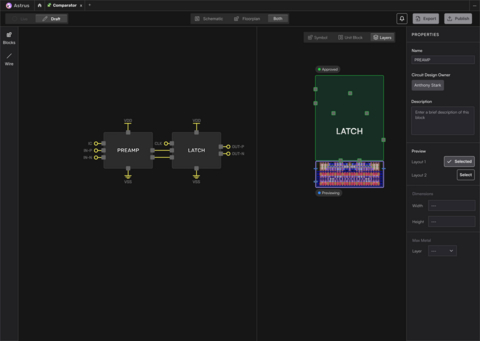
Astrus, a Canadian artificial intelligence startup developing physics-aware foundation models for semiconductor design, has secured $8 million in funding to accelerate automation in analog chip layout, one of the most time-consuming parts of microchip development.
The round was led by Khosla Ventures with participation from Pradeep Sindhu, founder of Juniper Networks, along with 1517 Fund, Drive Capital, Alumni Ventures, and other strategic backers.
While much of digital chip design has become automated, the analog portion—critical for advanced semiconductors—remains largely manual. Engineers typically place transistors individually, relying on expertise and intuition. The process can take months and cost hundreds of millions of dollars for cutting-edge designs.
Astrus aims to change that through its reinforcement learning architecture, which learns the physics underlying chip design. The company says its system can generate thousands of high-quality layouts in seconds, reducing workflows that traditionally require months to a matter of hours.
“Analog layout is one of the biggest bottlenecks in the design process for the most advanced microchips,” said Brad Moon, co-founder and CEO of Astrus. “Our AI learns the physics behind chip design, allowing us to automate what has always been a manual process. This funding enables us to accelerate chip development for the world’s leading teams and drive faster progress in compute.”
Founded in Toronto and Waterloo, Astrus brings together expertise in chip design and reinforcement learning. Moon, a former satellite-sensor chip designer, co-founded the company with Zeyi Wang, a reinforcement learning researcher trained by AlphaGo advisor Martin Müller. Their team includes Kenny Young, who studied under reinforcement learning pioneer Rich Sutton.
By adapting ideas behind AlphaGo to analog layout, Astrus is developing a foundation model it says can not only match human designers but also uncover new circuit architectures. “We’re scaling toward one of the largest reinforcement learning training runs ever attempted, engineered to push chip design past human limits,” said Young, the company’s founding research scientist.
With the fresh capital, Astrus plans to expand its research and engineering teams, scale compute infrastructure for large-scale training, and roll out tools for leading semiconductor companies working on advanced designs.